If you’ve ever taken a fitness class and thought, “Wow, this is HARD,” then you’re not alone! Feeling your muscles shake, burn, or fatigue during a workout is often a sign that you’re challenging yourself, and that’s a good thing.
But it’s important to know and understand that there’s a difference between struggling during a workout and straining during a workout. Knowing the difference can help you push your limits, build strength, and get more out of your fitness classes while also knowing when your body needs you to modify or stop.
What is Struggling During Exercise?
Struggling during exercise simply means your body is being challenged.
You might feel your muscles shaking during a barre hold, notice a deep burn during a strength exercise, or feel like those last few reps take significantly more effort. You may even think, “I don’t know if I can do one more!”
That feeling is completely normal. In fact, a good workout shouldn’t necessarily feel easy.
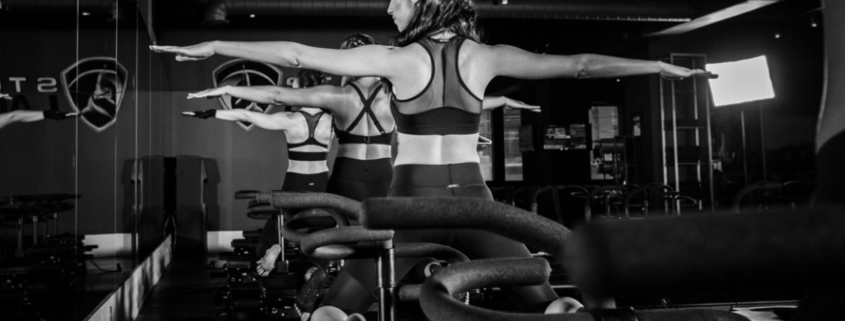
Whether you’re taking a Barre class, Mat Pilates class, a Lagree Megaformer workout, Strength class, or another group fitness class, your instructor is intentionally creating challenges that require your muscles to work.
And sometimes, that means you’re going to struggle.
When you challenge your muscles, they become fatigued. Over time, consistently challenging your muscles helps your body adapt and become stronger. You don’t necessarily need heavy weights to create that challenge, either. Bodyweight exercises, lighter weights, resistance bands, and even holding a position for an extended period of time can create plenty of resistance.
In other words, struggling doesn’t mean you’re doing something wrong. It means you’re working hard.
What Does Struggling Feel Like?
Everyone experiences exercise differently, but normal muscular fatigue can include:
- Muscles shaking or trembling
- A deep muscular burn
- Feeling fatigued toward the end of a set
- Needing extra concentration to maintain your form
- Feeling like you only have a few more reps left
- Having to work harder to hold a position
The key is that you’re still able to control the movement and maintain proper form.
That final rep might feel nearly impossible. Your legs might be shaking while pulsing in Barre class. Your core might be burning during Mat Pilates. Your arms might feel like they have nothing left during a Lagree class.
That’s the struggle, and it’s part of getting stronger.
What Is Straining During Exercise?
Straining is different from normal muscular fatigue.
Instead of feeling the expected challenge in the muscles you’re working, straining may feel like your body is signaling that something isn’t right. This can include sharp or sudden pain, pinching, pulling, unusual pressure, or pain in a joint rather than the working muscle.
You may also notice that you’re compensating for the movement, losing control of your form, or holding your breath because the exercise has become too difficult.
Straining is not something you need to push through.
While some discomfort is expected when challenging your muscles, pain that feels sharp, unusual, or concerning is a reason to stop and reassess the movement. Your workouts should challenge you, but you shouldn’t feel like you have to ignore pain or discomfort to prove you’re working hard.
Don’t Push Through Strain!
There’s a difference between challenging your body and ignoring its warning signs.
When you’re experiencing normal muscular fatigue, you can typically continue exercising with proper form and control. But if you’re experiencing sharp pain, joint pain, pinching, or another sensation that feels abnormal, continuing to push through it isn’t the goal.
Pushing past your comfort zone is encouraged. Pushing through pain is not. Your goal should be to challenge your body while still respecting its limits.
Struggling vs. Straining: What’s the Difference?
A simple way to think about it is:
Struggling = “This is hard.”
Straining = “Something feels wrong.”
Struggling typically comes from muscular fatigue and the effort required to complete a challenging exercise. Straining can be a sign that you need to modify the movement, reduce the intensity, or stop altogether.
Learning to recognize these signals is an important part of becoming a stronger and more confident exerciser.
Modifications Are Part of the Workout
At Mega Barre Youngstown, our instructors provide modifications throughout every class to help you find the right level of challenge for your body.
A modification doesn’t mean you’re taking the “easy” way out. It means you’re adjusting an exercise so you can continue getting a proper workout while maintaining control and good form.
You may need to decrease your range of motion, change your positioning, use lighter resistance, take a break, or try a completely different variation of an exercise.
There is no shame in modifying. In fact, knowing when and how to modify is an important part of becoming a stronger, more knowledgeable exerciser. We highly encourage modifying exercises when needed!
And if an exercise doesn’t feel right, tell your instructor! We can help you find a modification that still challenges the muscles you’re working without unnecessarily aggravating your body.
Challenge Yourself, But Listen to Your Body
The next time you’re in class and your muscles start shaking, don’t immediately assume you need to stop. Ask yourself: “Are my muscles working hard, or does something feel wrong?”
If you’re feeling the burn, fatigue, or shake while maintaining control, keep going. Challenge yourself beyond your comfort zone and see what you’re capable of.
But if you’re experiencing sharp, unusual, or concerning pain, stop and tell your instructor.
At Mega Barre Youngstown, we want you to embrace the shake, push your limits, and discover your strength. We also want you to feel confident knowing that our instructors are there to help you modify movements and find the right challenge for your body.
Ready to challenge yourself? Come take a class at Mega Barre Youngstown and see what you’re capable of!


